Press, Blogs & Articles
Adishankaracharya Bhagavatpaada
From Single Cell to Cosmic Consciousness: The Evolutionary Journey of Advaita and Srilalithadvaitam
By Parvathi Haritsa - Shivaniji,
Founder Peethadipati - Sahasradalayatakshee Lalitha Shaktipeetham Chaturamnayamathas, Adityahridayam Foundation, Srilalithadvaitam, Adishankaracharya Mandiram Shankarmutt.
From Single Cell to Cosmic Consciousness: The Evolutionary Journey of Advaita and Srilalithadvaitam
Introduction: The Premise of Non-Duality
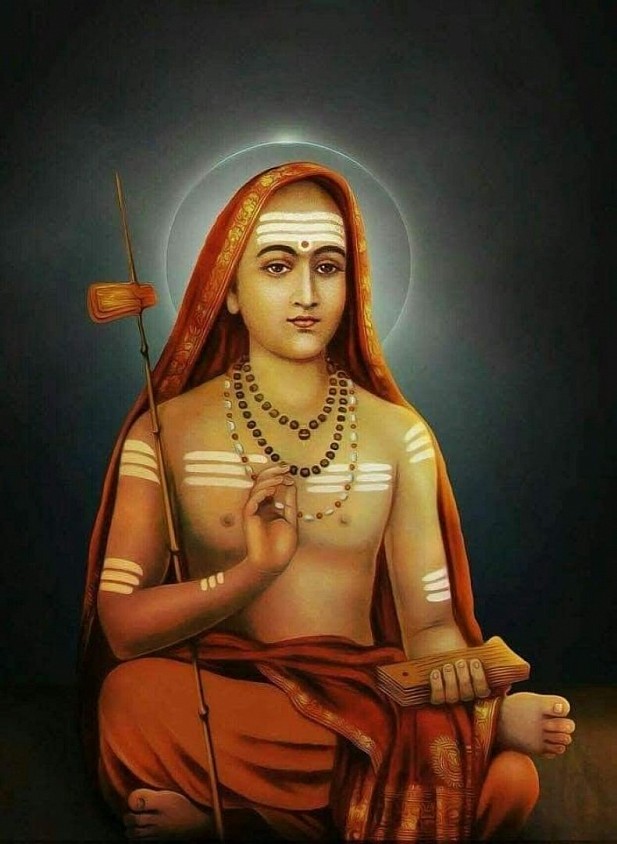
Adi Shankaracharya Bhagavatpaada conceptualised Advaita, the profound philosophy of absolute non-dualism. At its core, Advaita proposes a revolutionary truth: our individual consciousness (Atman) and the universal consciousness (Paramatman) are identical. The perceived separation exists only as long as we limit our identity to the mundane operations of daily life.
This raises a fundamental question: If we are already the supreme identity, why do we experience struggle? Why must we perform action (karma) to achieve goals?
The Law of Inertia and the Biological Imperative
As long as we possess a physical existence and identify with the body-mind complex, action is an absolute necessity. Much like Newton’s First Law of Motion, an object remains in a state of inertia unless acted upon by an external force. In the realm of consciousness, without intentional action, we remain stagnant. True manifestation through thought alone belongs exclusively to the state of "just being"—a realm beyond body-mind identification.
Consider the evolutionary history of Earth. Billions of years ago, life manifested as single-celled organisms like amoebas and hydras. In Hindu scriptural symbology, this initial aquatic stage corresponds to the Matsya (fish) avatar of Vishnu. If those primordial organisms had chosen inertia—merely eating, sleeping, and dying without the struggle to divide, multiply, and evolve—humanity would not exist today.
It was the persistent struggle for survival that drove genetic mutations, transforming single-celled life into complex multicellular marine organisms like fish, octopuses, and crustaceans. Looking beyond the water, these organisms strived further, mutating into amphibians to experience both land and sea. To survive harsher terrains, they mutated into reptiles, learning to navigate tight spaces for safety.
The Alignment of the Spine and Cognition
The evolutionary drive forced a monumental structural shift: the development of the spine in mammals. As primates evolved into bipedal beings like chimpanzees and hominids, the spine gradually became erect. Spiritually, this physical straightening removed the biological resistance to vital energy, allowing the Kundalini to ascend effortlessly to the Ajna chakra (the third eye).
Only at this precise evolutionary juncture did life gain the capacity for advanced cognition, prompting the ultimate metaphysical questions: "Who am I?" and "What is my purpose?"
As human beings migrated across the planet, developing diverse skin tones and traits based on climate and pre-frontal cortex development, the chaotic hunter-gatherer lifestyle yielded to stable agrarian civilisations. To govern expanding populations and instil order in an inherently violent world, humanity institutionalised systems of belief and social structures.
Deconstructing Deities: The Thin Line Between God and Demon
To maintain social order, early societies created heavenly deities equipped with supernatural powers to reward or punish human actions. But what did the ancient rishis, munis, and philosophers truly mean by "heavenly gods"?
The deities described in religious texts represent our own consciousness operating at higher chakras—the source of profound compassion, kindness, and dormant supernatural potentials (siddhis). Secular and religious control structures often obscure this truth; for if collective human awareness consistently resided at the Sahasrara (crown) chakra, external self-proclaimed authorities would lose their power to control.
This heightened awareness and the discriminatory intellect (buddhi) to choose between altruism and manipulation is what defines the boundary between the divine and the demonic. Humanity does not belong permanently to either category; we are a continuous blend of both. In our daily lives, we constantly cycle through the roles of God, demon, and human—a psychological reflection of the Holy Trinity (Triveni, the culmination of Ida, Pingala & Sushumna) operating between the Muladhara and Ajna chakras.
The Ladder of Yoga: From Ritual to Realisation
To navigate this spiritual evolution, systemic pathways were established:
Karma Yoga: The entry point. Action is performed as worship, neutralizing personal desires to purify the mind and body.
Bhakti Yoga: When human efforts falter, the seeker turns to emotional surrender (prapatti) toward an Ishta Devta (chosen deity). Channelling love and vital force (prana) toward an external idol purifies the emotional body.
Gyana Yoga: With a purified mind, the seeker turns to scriptures to investigate the perceived distance between themselves and the deity, unlocking internal siddhis and embodying the traits of the divine.
Raja Yoga: The final psychological practice where the seeker consciously raises the Kundalini through the chakras to merge with cosmic consciousness (Sadaashiva\Paramashiva).
During this progression, a critical trap emerges. As individuals uncover their inner divinity, they must recognise that the exact same divinity resides in all others. Forgetting this detail leads to the delusion of spiritual ego—believing oneself to be the sole source of divinity.
True Advaita manifests when we view our defects and genetic predispositions (samskaras) as raw material to be perfected through Sadhana (disciplined practice). At this stage, social divisions like varnas, genders, and labels dissolve. Outer actions are driven purely by Dharma and public wellbeing. This is illustrated by Goddess HH Lalitha Mahatripurasundari Parabhattarika seated on top of Sadaashiva\Paramashiva as the base of her seat, and Brahma, Vishnu, Rudra, Eshwara as the four legs of her Simhasana to depict that she's above creation, sustenance, dissolution, concealment & divine grace - a symbol of conquering animalistic samskaras to let universal compassion flow naturally.
Srilalithadvaitam: The Ultimate Science: The Creme of Advaita
The pinnacle of this evolutionary understanding is Srilalithadvaitam, the profound process of recognizing the exact same divinity within ourselves as we do in the external universe. It is a path of healing, absolute forgiveness, and recognizing the human body-mind complex as a living Sriyantra.
Remarkably, the eons it took for life to evolve on Earth are mirrored inside a mother's womb. In just nine months, a single cell (the zygote) replicates the macrocosmic evolutionary timeline to become a complex intellectual being—proving that time operates on a completely different dimension within that sacred space of a mother's womb.
Why do schools of Srilalithadvaitam view texts like the chandipath and durga saptashati as inferior sciences (abhichara)?
Because they operate strictly on the immutable laws of cause and effect (the spiritual equivalent of Newton’s Third Law) and within the realms of karma where evolution isn't complete and humans use the siddhis to manipulate others for their personal gains, it's main purpose being Dharma, Artha & Kama and not Moksha.
The chakras from Muladhara to Ajna are known as Kula chakras. These centers bind an individual to family, community, society, and karmic obligations. Conversely, the Sahasradala (crown) chakra is Akula—entirely free from worldly bondage and karmic consequences.
Just as Earth's gravity only exerts its power within a specific atmospheric threshold, karmic debts only bind us within the Kula chakras. A spacecraft with sufficient velocity and energy escapes gravitational pull; similarly, a seeker requires the acceleration in the kundalini's ascent through Sadhana to transcend the Ajna chakra. Once consciousness ascends into the Akula (Sahasrara) and above, the individual breaks free from worldly gravity. This ultimate liberation is the very core - Srilalithadvaitam, the crème de la crème, of Advaita philosophy. As per Srilalithadvaitam one doesn't have to renounce material life for liberation, HH Sahasradalayatakshee Lalitha Mahatripurasundari Parabhattarika grants through knowledge to her sadhakas the ability to enjoy a material life (Bhoga) while striving & attaining Moksha.
Adishankaracharya Samaarambham Manikanthan Annan Madhyamam Amritapadananda Paryantam
Vande Guruparamparaam
Dattatreya Samaarambham Swaprakashananda Madhyamam Amritapadananda Paryantam
Vande Guruparamparaam
Lalitha Samrajyam Shaiva Kutumbam
Srilalithadvaitam Eeva Jayate
Shankarah Deshika Me Sharanam
Namonamaha Gurupadukabhyam
Sarvadevah Namaskaraha Lalithaam Pratigachhati